For Platform Partners
Integration-ready today. Three parameters per user. Every metric derived.
TrueZone is an SDK and API that turns existing heart rate data into real physiological insight. No change to your hardware, no change to your user experience. Just better science underneath.
The Problem
Every platform shares the same limitations.
Across the entire wearable industry, the core science is unchanged: a VO₂max estimate extrapolated from heart rate response, fixed percentage-based zones, and heuristic recovery scores. None of them model endurance, detect real metabolic thresholds, or individualize training zones.
Endurance Score is a heuristic composite, not a physiological parameter. Lactate threshold inferred from guided tests. Zones still percentage-based. No unified model connecting thresholds, endurance, and metabolism.
Cardio Fitness reduced to a single VO₂max number. Fixed percentage zones with no physiological basis. No threshold detection, no endurance modelling, no metabolic insight.
Strain and recovery indices from HRV and HR. No direct endurance, threshold, or metabolic metric. No physiological model underlying the scores.
Running Index and orthostatic tests available. Zones still generic percentage-based. No individualized endurance parameter or metabolic modelling.
VO₂max and threshold estimates via EvoLab. No endurance parameter. No metabolic zones or substrate modelling. Threshold detection requires structured efforts.
VO₂max estimate and coaching features. No physiological threshold mapping, no endurance metric, no metabolic modelling.
What You Get
A science layer that drops into your stack.
No hardware change
01TrueZone works with existing heart rate and speed/power data. No new sensors, no firmware updates. Your users' existing data is enough.
Bayesian accumulation
02Parameters refine automatically with each activity session. No calibration test required. Accuracy improves over time from ordinary use.
Patent protected
03One granted patent and one pending, filed in both the US and Europe. Protection extends to 2045. A defensible moat for platform partners.
Sport-universal
04The same model architecture fits running, cycling, walking, and team sports without sport-specific tuning. One SDK, all activities.
Full metric suite
05From three parameters: endurance, HRmax, VO₂max, thresholds, zones, race predictions, fat oxidation, energy expenditure, and recovery kinetics.
Transparent parameters
06Unlike black-box ML models, every output is physiologically interpretable and trackable over time. Users can see exactly what changed and why.
Real-time capable
07The model runs forward in time. Live time-to-exhaustion, fatigue prediction, pacing guidance, and substrate balance — not just post-session summaries.
Integration
Three steps to real physiology.
- 01
Send activity data
Heart rate + speed (or power) streams from any wearable or app, via REST API.
- 02
TrueZone processes
The ODE model fits each session. Bayesian memory accumulates across sessions.
- 03
Receive full profile
Three converged parameters and every derived metric returned per user.
{
  // 01 — send
  "stream":  [ "hr", "speed | power" ],

  // 02 — fit
  "model":   "bayesian_ode",

  // 03 — receive
  "profile": {
    "E":     0.74,
    "Vmax":  5.42,
    "HRmax": 187,
    "derived": "60+ metrics"
  }
}In Practice
What your users see.
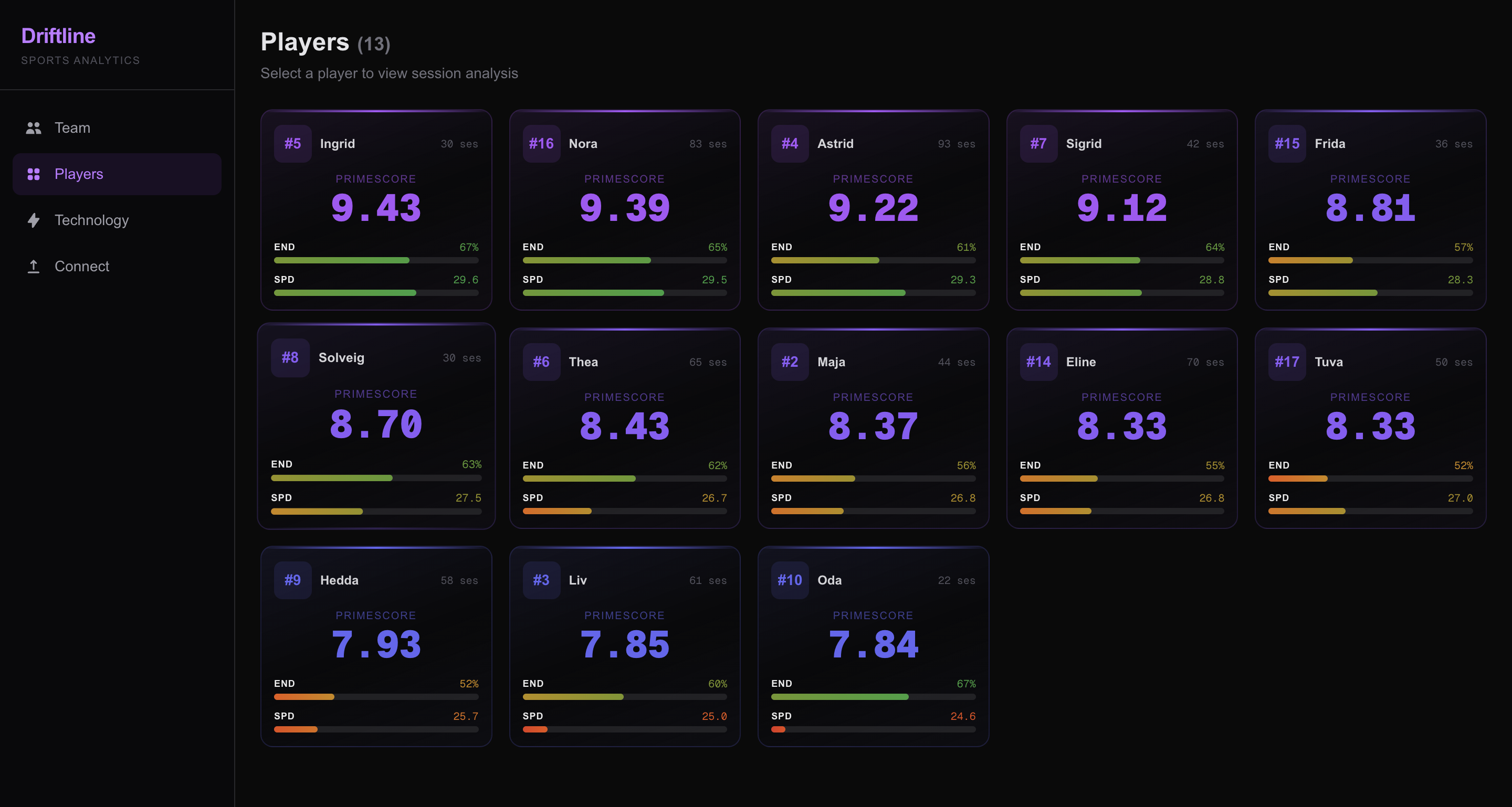
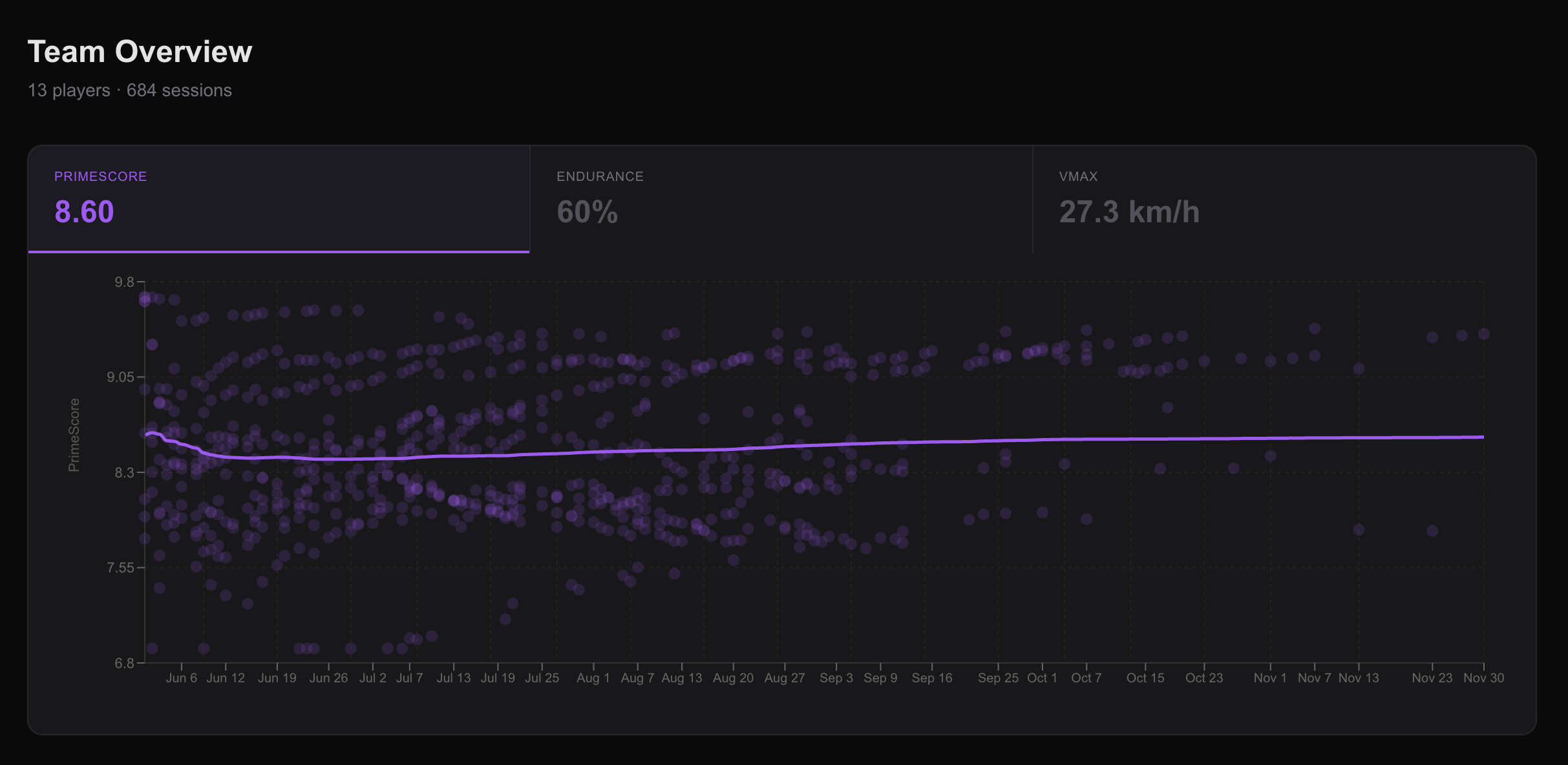
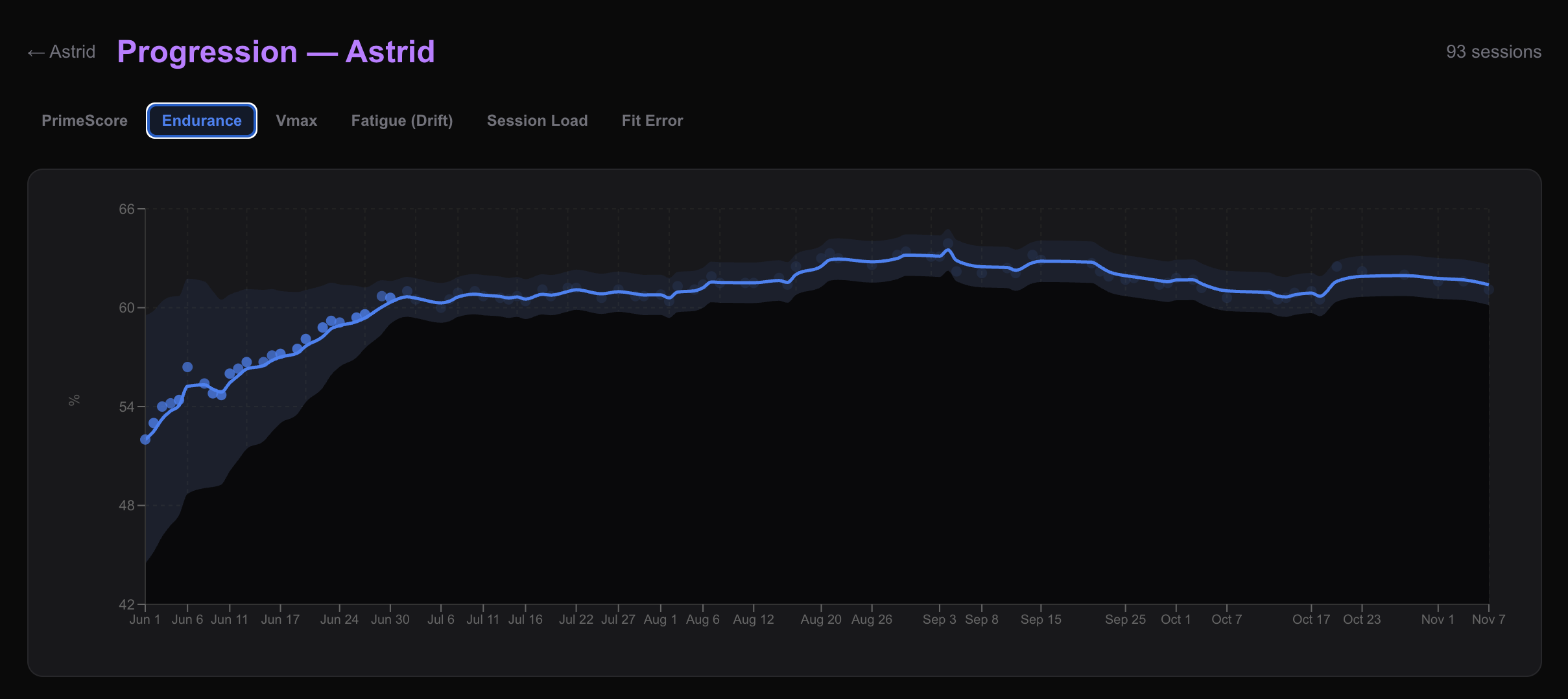
TrueZone outputs are designed for individual athletes, coaching staff, and platform dashboards alike. Here's an example of what the data looks like for a professional football team tracked across a full season.
Intellectual Property
Patent-protected technology.
Driftline holds one granted patent and one pending patent for heart rate kinetics modelling and aerobic endurance estimation, filed in both the United States and Europe. Protection extends to 2045, providing a defensible moat for platform partners who integrate TrueZone.
FAQ
Common questions.
What data format do you need?
Heart rate and speed (or power) as time-series arrays. Sample rates from 1 Hz down to once every 6 seconds work well. JSON or CSV via REST API. Standard wearable export formats are supported.
How quickly does a user get results?
The model produces a full physiological profile from the first session. Parameters refine with each subsequent session, typically converging within 3–10 activities.
Does it work with optical heart rate sensors?
Yes. The model is designed for consumer-grade wearable data. Optical HR from wrist-worn devices works well for steady-state and variable-pace activities.
What about indoor cycling or treadmill running?
Fully supported. Indoor cycling uses power data. Treadmill running uses the set speed. No GPS required.
How is TrueZone priced?
Contact us to discuss pricing for your platform and expected user volume.
f(E, V, P) → profile
Ready to add real physiology to your platform?
We work with wearable companies, training apps, sports analytics platforms, and digital health providers. The SDK is ready today.